
7 Lightweight Packs for British Thru-Hiking & Wild Camping
For any serious backpacker, the “Big Three” — your shelter, your sleep system, and your pack — represent the heaviest items in your kit and the biggest opportunity for weight savings. While tents and sleeping bags often get the limelight, the backpack is the foundational piece that carries everything. It’s the interface between you and your gear, and getting it right is paramount to enjoying your time on the trail. However, finding the perfect pack for UK conditions presents a unique challenge. Our notoriously fickle weather means we often need to carry more robust shelters and warmer layers than our American counterparts, pushing base weights up. The problem, then, is finding a pack that is light enough to be considered ‘ultralight’ yet comfortable and durable enough to carry a typical UK kit over boggy, steep, and varied terrain.
This is where our expert guide comes in. We’ve spent countless hours researching, analysing specifications, and scouring real-world user feedback to bring you the definitive list of the best ultralight backpacks UK hikers can buy in 2025. We understand that a pack that excels on the Pacific Crest Trail might not be the best choice for a wet week on the Pennine Way. Our review focuses on packs that strike the crucial balance between low weight, carrying comfort, and features relevant to British thru-hiking and wild camping. We’re targeting the sweet spot for most UK multi-day hikers: a base weight of around 5-7kg, which allows for a comfortable total pack weight of 10-12kg once food and water are added. From the undisputed champion of the trails to the budget-friendly workhorse, this comprehensive roundup will help you find the perfect lightweight pack to complete your Big Three and make your next adventure lighter, faster, and more enjoyable.
2. Quick Comparison Table
| Pack Name | Weight | Capacity | Torso Fit | Price Range | Max Load | Best For |
|---|---|---|---|---|---|---|
| Osprey Exos 48 | ~1.29 kg | 48 L | Adjustable | £190 – £200 | ~14 kg | The versatile all-rounder for weekend trips and shorter thru-hikes. |
| Osprey Exos 58 | ~1.32 kg | 58 L | Adjustable | £200 – £220 | ~16 kg | The classic thru-hiker’s choice for long-distance UK trails. |
| Osprey Exos Pro 55 | ~0.97 kg | 55 L | S/M, L/XL | £198 – £240 | ~12 kg | Serious ultralight hikers pushing for a sub-5kg base weight. |
| Deuter Aircontact Ultra 50+5 | ~1.27 kg | 50+5 L | Adjustable | £180 – £200 | ~15 kg | Hikers wanting robust German engineering and comfort at a great weight. |
| Gregory Paragon 50 | ~1.63 kg | 50 L | Adjustable | £190 – £210 | ~23 kg | Comfort-focused hikers who value features and load-hauling over pure minimalism. |
| Osprey Exos 38 | ~1.19 kg | 38 L | Adjustable | £140 – £150 | ~11 kg | Fast-and-light overnights and minimalist weekend trips. |
| Mountain Warehouse High 50L | ~1.5 kg | 50 L | Fixed | £50 – £70 | ~15 kg | Beginners and budget-conscious hikers needing a functional, affordable pack. |
3. Understanding Pack Weight Classes
The term ‘ultralight’ can be confusing, as it means different things to different people. In the world of backpacks, weight is a critical specification that often dictates the pack’s design, features, and intended use. Understanding these weight classes helps you align your pack choice with your overall gear philosophy and base weight.
- Ultralight (Sub-900g): These are the featherweights of the pack world, often frameless or using minimalist carbon fibre frames. They are built for hikers with a dialed-in, sub-5kg base weight. To use these packs comfortably, every item in your kit must be scrutinised for weight. They often sacrifice features like extensive padding, multiple pockets, and robust materials to shed every possible gram. They are best for experienced minimalists on well-trodden paths.
- Lightweight (900g – 1.3kg): This is the sweet spot for the vast majority of UK ultralight and lightweight backpackers. Packs in this category, like the Osprey Exos and Deuter Aircontact Ultra, offer a fantastic compromise. They typically feature a proper internal frame, a comfortable suspension system, and useful features like hip belt pockets and stretch mesh pouches, all while keeping the weight impressively low. They can comfortably handle the 5-7kg base weights common in the UK.
- Standard (1.3kg – 1.8kg+): While not strictly ‘ultralight’, these packs, such as the Gregory Paragon, often prioritise carrying comfort, adjustability, and durability over absolute low weight. They are an excellent choice for those new to multi-day hiking, those carrying slightly heavier loads (e.g., for winter or with family), or hikers who simply refuse to compromise on comfort. The extra few hundred grams often translate into plusher padding, more robust fabrics, and convenient features like full-length access zips.
Your base weight (the weight of all your gear, excluding consumables like food, water, and fuel) is the primary factor in determining which pack class is right for you. A heavy, feature-rich pack is overkill for a 4kg base weight, while an ultralight frameless pack will be a painful experience with a 10kg base weight. Calculate your base weight first, then choose your pack.
Top 7 Ultralight Backpacks for the UK

Osprey Exos 48 ★★★★☆
£190 – £200
Weight: ~1.29 kg (S/M)
Capacity: 48 litres (S/M)
Torso Range: S/M (43-52 cm), L/XL (49-59 cm)
Max Comfortable Load: 11-14 kg
Check Price on AmazonThe Osprey Exos 48 has become a ubiquitous sight on British trails, and for good reason. It represents the quintessential balance of lightweight design, carrying comfort, and practical features that most UK hikers crave. It’s the gateway pack for many dipping their toes into the world of lightweight backpacking, offering a significant weight saving over traditional packs without the intimidating minimalism of true ultralight models. The heart of the Exos is its AirSpeed suspended mesh back panel. This ‘trampoline’ system creates a generous air gap between your back and the pack, providing unrivalled ventilation—a huge bonus on humid climbs in the Brecon Beacons or Lake District. The 2022 update brought a crucial improvement: an injection-moulded ladder system offering 10cm of torso adjustability, making it far easier to dial in a perfect fit.
For UK use, the Exos 48 hits a capacity sweet spot. It’s ample for a 2-3 day trip, even with the requisite waterproofs and warm layers. The organisation is superb for a lightweight pack. The large front stretch-mesh ‘shove-it’ pocket is perfect for stashing a wet rain jacket, while the dual-access side pockets can be reached without taking the pack off. The re-introduction of zippered hip belt pockets was a welcome change, though they are still on the small side—barely fitting a modern smartphone. Durability is a fair compromise; the 100D high-tenacity nylon is tough enough for general trail use but requires a bit more care around sharp rocks than heavier packs. For many UK hikers, the Exos 48 is the ‘Goldilocks’ pack: not too heavy, not too minimalist, but just right for the majority of multi-day adventures.
Pros
- Excellent ventilation from AirSpeed back panel
- Great balance of weight, comfort, and features
- Adjustable torso length for a dialed-in fit
- Superb external pockets for organisation
- Widely available in UK retailers
Cons
Hip belt pockets are frustratingly smallNot the lightest option availableRain cover not included
Verdict: The Osprey Exos 48 is arguably the best all-round lightweight backpack for most UK hikers. Its blend of supreme comfort, excellent ventilation, and smart features at a sub-1.3kg weight makes it a reliable and versatile choice for everything from a Dartmoor weekend to a week on the West Highland Way.


Osprey Exos 58 ★★★★☆
£200 – £220
Weight: ~1.32 kg (S/M)
Capacity: 58 litres (S/M)
Torso Range: S/M (43-52 cm), L/XL (49-59 cm)
Max Comfortable Load: 14-16 kg
Check Price on AmazonTake everything that makes the Exos 48 great and add 10 litres of volume for just a few dozen extra grams, and you have the Exos 58. This is the classic choice for long-distance thru-hikers, both in the US and increasingly here in the UK. That extra capacity is invaluable on trails with long stretches between resupply points, like the Pennine Way, or for those undertaking winter trips where bulkier insulation and safety gear are non-negotiable. The Exos 58 shares the same DNA as its smaller sibling: the fantastic AirSpeed suspension, adjustable torso, and a well-thought-out feature set. The load-carrying comfort is exceptional up to its recommended limit of around 16kg, with the LightWire frame effectively transferring weight to the hips.
The pack’s versatility is a key selling point. The floating lid can be removed to save around 120g, and the integrated FlapJacket cover keeps your gear protected when running in this minimalist mode. This modularity is perfect for adapting the pack to different trip lengths. UK user feedback consistently praises its ability to swallow gear for a week-long trip while remaining comfortable and stable on tricky terrain. One hiker on the Cape Wrath Trail noted how the pack handled a full load plus seven days of food without issue. Like the 48, the main complaints centre on the small hip belt pockets and the lack of an included rain cover—a baffling omission for a pack sold in the UK market. However, these are minor gripes on what is otherwise a masterclass in pack design. For those planning extended trips or who just prefer the security of extra space, the Exos 58 is one of the best ultralight backpacks UK thru-hikers can choose.
Pros
- Huge volume-to-weight ratio
- Comfortably carries loads up to 16kg
- Removable lid for weight savings and versatility
- Proven performance on long-distance trails
- Excellent ventilation and adjustability
Cons
Hip belt pockets are too small for modern phonesNo included rain coverCan encourage overpacking if not disciplined
Verdict: The Exos 58 is the long-distance champion. If you’re tackling a UK national trail or need the extra capacity for four-season adventures, its combination of volume, comfort, and low weight is almost impossible to beat.

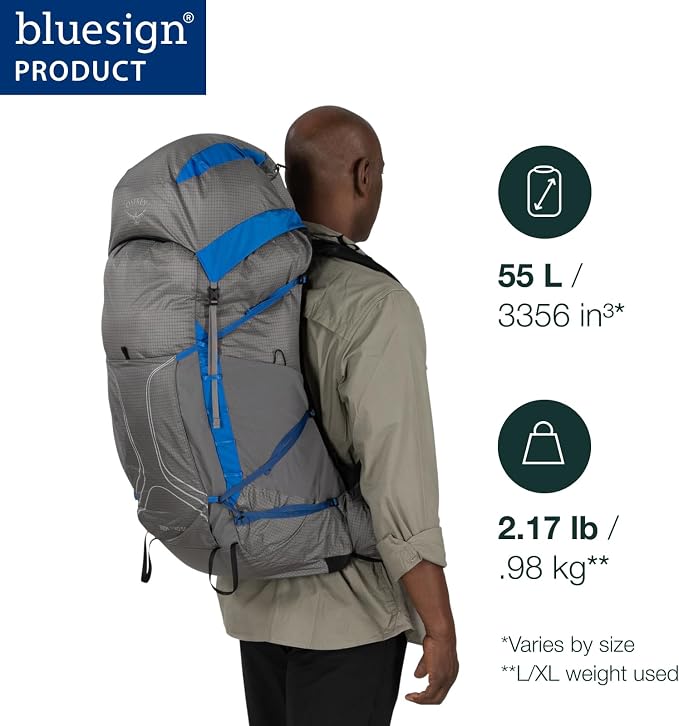
Osprey Exos Pro 55 ★★★★☆
£198 – £240
Weight: ~0.97 kg (S/M)
Capacity: 55 litres (S/M)
Torso Range: S/M, L/XL (Fixed sizes)
Max Comfortable Load: 12 kg
Check Price on AmazonThe Exos Pro 55 is Osprey’s answer to the demands of the hardcore ultralight community. By stripping the standard Exos design back to its essentials, they’ve managed to break the coveted 1kg barrier, creating a pack with a phenomenal volume-to-weight ratio. This is a different beast to the standard Exos. The harness is less padded, the fabrics are lighter (NanoFly 100D), and features are more minimalist. There is no torso length adjustment; you buy it in one of two sizes, so trying it on for fit is absolutely critical. The suspension is a simplified version of the AirSpeed system, still providing good ventilation but with less structure. This pack is designed for those who have already optimised every other piece of their kit.
Despite its minimalist ethos, the Exos Pro retains some key Osprey DNA. You still get the large front mesh pocket, decent side pockets, and the Stow-on-the-Go trekking pole attachment. The top lid is removable, and a simple FlapJacket is included. The hip belt pockets, while still present, remain small. The key difference is in the carry. This pack is not designed to be loaded up with 15kg of gear for a week. It excels with total pack weights under 12kg, where it feels nimble and agile. For a UK hiker with a highly refined, sub-5kg base weight, this pack is a dream for fast-and-light missions in the Scottish Highlands or on European trails like the GR20. However, if your base weight is creeping towards 7kg or more, the standard Exos will provide a much more comfortable experience for a negligible weight penalty. This is a specialist tool for the dedicated ounce-counter.
Pros
- Incredibly lightweight at under 1kg
- Massive 55L capacity for the weight
- Retains key features like mesh pockets and pole storage
- Excellent for experienced ultralight hikers
Cons
Fixed torso length requires careful sizingReduced padding and comfort with heavier loadsLighter fabrics are less durablePremium price point
Verdict: For the dedicated ultralight purist, the Exos Pro 55 is a game-changer. It offers the volume of a traditional pack at a weight that rivals minimalist cottage-industry brands, backed by Osprey’s design expertise. Just be sure your base weight is low enough to justify it.


Deuter Aircontact Ultra 50+5 ★★★★☆
£180 – £200
Weight: 1.27 kg
Capacity: 50 + 5 litres
Torso Range: 42-62 cm (Adjustable)
Max Comfortable Load: 15 kg
Check Price on AmazonDeuter has a long-standing reputation for building bomb-proof, comfortable packs, albeit often on the heavier side. The Aircontact Ultra 50+5 is their brilliant foray into the lightweight world, blending their traditional engineering prowess with modern weight-saving design. Weighing in at just under 1.3kg, it’s a direct competitor to the Osprey Exos 58 but offers a distinctly different feel. Instead of a trampoline-style back panel, it uses Deuter’s Aircontact system with Air Spacer Mesh. This design keeps the load closer to your back for better stability—a noticeable advantage on technical, off-balance terrain—while still providing effective ventilation channels. The result is a pack that feels incredibly stable and planted.
Where the Deuter truly shines is its adjustability and load-carrying comfort. The VariSlide back length adjustment is simple and offers a huge range (42-62cm), accommodating a wide variety of torso sizes. The ActiveFit shoulder straps and VariFlex hip fins pivot with your body’s movement, creating a dynamic, body-hugging fit that reduces fatigue on long days. The feature set is comprehensive: a removable lid that adds 5L of capacity, generous zippered hip belt pockets that actually fit a phone, modular gear straps, and a large front mesh pocket. Built from 175D polyamide, it feels a touch more durable than its direct competitors. For UK hikers who prioritise a stable carry and a customisable fit over maximum ventilation, the Deuter Aircontact Ultra 50+5 is one of the best lightweight backpacks available, offering superb German engineering at a very competitive weight and price.
Pros
- Excellent load stability and carrying comfort
- Highly adjustable back system fits a wide range of torsos
- Robust build quality and durable materials
- Generously sized and useful hip belt pockets
- Great value for a feature-rich lightweight pack
Cons
Back panel ventilation is good, but not as airy as Osprey’s meshSlightly heavier than some direct competitorsRain cover not included
Verdict: The Deuter Aircontact Ultra 50+5 is a triumph of engineering. It offers a supremely comfortable and stable carry, outstanding adjustability, and a robust feature set, making it a top contender for any UK hiker looking for a reliable, do-anything lightweight pack.

Gregory Paragon 50 ★★★☆☆
£190 – £210
Weight: 1.63 kg (M/L)
Capacity: 50 litres
Torso Range: S/M (38-48 cm), M/L (46-56 cm)
Max Comfortable Load: 23 kg
Check Price on AmazonWhile pushing the upper limit of what can be called ‘lightweight’, the Gregory Paragon 50 earns its place on this list by offering a level of comfort and load-hauling capability that lighter packs simply can’t match. If your base weight is on the higher side (7kg+), or you regularly carry gear for others, the Paragon is an outstanding choice. Its FreeFloat dynamic suspension system is the star of the show, featuring a tensioned mesh back panel for breathability combined with a hip belt that flexes and pivots with your body. This creates a ride that is both airy and incredibly supportive, making 15kg feel more like 12kg. The adjustability is top-tier, with an adjustable torso and a unique system that allows the hip belt padding to be extended for a perfect, hotspot-free fit.
The Paragon is packed with features that enhance life on the trail. A full-length side zipper provides duffel-bag-style access to the main compartment, eliminating the need to unpack everything to find an item at the bottom. It also includes a separate zippered sleeping bag compartment, generous hip belt pockets, and an included rain cover tucked away in its own pocket—a thoughtful touch for the UK market. At over 1.6kg, it’s significantly heavier than the Exos or Aircontact Ultra, but its recommended max load of 23kg is in a different league. This makes it a superb option for multi-day winter trips in Scotland or for parents carrying a share of their children’s gear. It’s the pack for the hiker who says, “I’ll carry an extra 400g in the pack itself if it means the 15kg inside it feels comfortable all day.”
Pros
- Exceptional carrying comfort, especially with heavier loads
- Highly adjustable torso and hip belt for a custom fit
- Feature-rich, including a side-access zip and included rain cover
- Durable construction and materials
- Excellent value for its feature set
Cons
Heavy for a ‘lightweight’ pack at over 1.6kgSuspension can feel over-engineered for truly light loadsHip belt pockets could be larger
Verdict: The Gregory Paragon 50 is a comfort-first workhorse. It’s the ideal choice for backpackers who aren’t chasing the lowest possible base weight but instead want a supremely comfortable, durable, and feature-rich pack that can handle heavier loads with ease.


Osprey Exos 38 ★★★☆☆
£140 – £150
Weight: 1.19 kg (S/M)
Capacity: 38 litres (S/M)
Torso Range: S/M (43-52 cm), L/XL (49-59 cm)
Max Comfortable Load: 9-11 kg
Check Price on AmazonThe Osprey Exos 38 takes the celebrated Exos formula and shrinks it down for minimalist adventures. It’s the perfect pack for the disciplined ultralight hiker on a quick overnight trip or for longer hut-to-hut style treks where you’re not carrying a shelter or full cooking system. It shares all the best features of its larger siblings, including the supremely ventilated AirSpeed back panel, adjustable torso length, Stow-on-the-Go pole attachment, and a removable lid. At just under 1.2kg, it’s not dramatically lighter than the 48L version, so the choice to go with the 38L is purely about volume discipline and a more compact, agile feel.
With a 38-litre capacity, packing needs to be intentional. It’s ideal for a summer setup with a sub-1kg tent or tarp, a quilt, and a minimalist cook system. The limited volume forces you to make smart choices and leave non-essentials at home, which is the essence of the ultralight philosophy. For UK conditions, it excels on routes like the South Downs Way or for a quick weekend blast in the Peak District. However, its limited capacity makes it a challenging choice for longer trips or in shoulder seasons where more insulation is required. The recommended load range tops out around 11kg, and the pack feels best with loads under 10kg. If you’re a dedicated minimalist who enjoys the challenge of packing light, or you need a pack for fast-paced mountain days and overnighters, the Exos 38 is a superb, comfortable, and well-ventilated option.
Pros
- Compact, agile, and stable on the move
- Excellent ventilation and carrying comfort for light loads
- Encourages minimalist packing
- Full feature set in a smaller package
Cons
Limited capacity for UK multi-day tripsNot significantly lighter than the 48L versionSmall hip belt pocketsNiche use case for many hikers
Verdict: The Exos 38 is a specialist’s tool for fast-and-light adventures. If your trips are typically 1-2 nights and your gear is truly dialed-in, it offers the fantastic Exos comfort in a nimble, low-volume package.

Mountain Warehouse High 50L ★★☆☆☆
£50 – £70
Weight: 1.5 kg
Capacity: 50 litres
Torso Range: Fixed
Max Comfortable Load: 15 kg
Check Price on AmazonIn a market dominated by packs costing upwards of £200, the Mountain Warehouse High 50L stands out for one primary reason: incredible value. It would be unfair to compare its features and performance directly to an Osprey or a Deuter, but for less than the price of a fancy pub dinner, you get a functional 50-litre backpack that will get you out on the trail. This makes it an unbeatable choice for those just starting out, for growing teenagers on Duke of Edinburgh expeditions, or for anyone who can’t justify a large outlay on gear. The design is simple and traditional. It features a padded airmesh back system, which provides some cushioning and airflow, but lacks the sophisticated suspension and load transfer of premium packs. The torso length is fixed, so getting a good fit is a matter of luck; it’s crucial to try this pack on in-store.
The feature set is basic but covers the essentials. You get a main compartment with a drawcord closure, a lid with a pocket, side pockets for water bottles, and compression straps. The materials and zippers are not as robust as on high-end models, so it requires more careful handling. At around 1.5kg, it’s a similar weight to the much more comfortable and feature-rich Gregory Paragon, highlighting the trade-offs made to hit its low price point. While it won’t win any awards for innovation or comfort on a long, arduous trek, the High 50L successfully lowers the barrier to entry for backpacking. For shorter, less demanding trips, and for those who just need a bag to carry their stuff from A to B without breaking the bank, it’s a perfectly adequate and commendable option.
Pros
- Exceptional value for money
- Good capacity for multi-day trips
- Simple, easy-to-use design
- Accessible and widely available
Cons
Basic and less comfortable suspension systemFixed torso length may not fit everyoneHeavier than modern lightweight designsLower quality materials and components
Verdict: The Mountain Warehouse High 50L is the budget champion. It makes backpacking accessible to all. While it lacks the refinement and comfort of premium packs, its functionality at this price point is unmatched. A fantastic starting point for new adventurers.
5. Load Capacity Guide for UK Trips
Choosing the right pack capacity is a balancing act. Too small, and you’ll be dangerously leaving essentials behind or uncomfortably strapping gear to the outside. Too large, and you’ll inevitably fill the space, carrying unnecessary weight. The key is to match your pack’s volume to your typical total load, which is calculated with a simple formula:
Total Pack Weight = Base Weight + Consumables Weight
Your base weight is the fixed weight of your gear (pack, tent, sleeping system, clothes, etc.). Your consumables are items that vary with trip length, primarily food and water. In the UK, a good rule of thumb is to budget 0.8-1kg of food per person per day and to carry 1-2 litres of water, refilling whenever possible.
Let’s take a West Highland Way (WHW) trip in summer as an example. This is a 7-day trip with frequent resupply options.
• Base Weight: A realistic UK lightweight base weight is 6kg.
• Consumables: You might carry a maximum of 2 days’ food at any time (~1.5kg) and 2 litres of water (2kg).
• Total Weight: 6kg + 1.5kg + 2kg = 9.5kg.
This total load fits comfortably within the volume and weight limits of a 40-50 litre pack.
Pack Capacity Matching:
- 35-45 Litres (e.g., Osprey Exos 38): Ideal for minimalist summer overnights, hut-to-hut tours, or thru-hikes with daily resupply. This size forces discipline and is best for those with a sub-5kg base weight.
- 45-55 Litres (e.g., Osprey Exos 48, Deuter Aircontact Ultra 50+5): The versatile sweet spot for most UK 3-season backpacking. This volume comfortably accommodates a 2-4 day trip’s worth of food and gear and is sufficient for longer trails with regular resupply like the WHW.
- 55-65 Litres (e.g., Osprey Exos 58): Best for longer thru-hikes with resupply stretches of 4+ days (e.g., parts of the Pennine Way or Cape Wrath Trail), shoulder-season trips with bulkier clothing, or full winter backpacking where you need space for larger sleeping bags, more layers, and safety equipment like ice axes and crampons.
6. Pack Fit and Sizing for the UK Market
A 900g pack that fits poorly will feel heavier and more miserable than a 2kg pack that fits perfectly. Fit is, without question, the single most important factor when choosing a backpack. An ill-fitting pack will create hotspots, strain your shoulders, and fail to transfer the load to your hips, turning a beautiful hike into a painful ordeal. The foundation of a good fit is matching the pack’s frame size to your torso length.
How to Measure Your Torso Length:
You’ll need a friend and a flexible tape measure for this.
- Tilt your head forward and find the most prominent bony bump at the base of your neck. This is your C7 vertebra, the top of your measurement.
- Place your hands on your hips, with your thumbs pointing backwards towards your spine. Your thumbs should be resting on the top of your hip bones (the iliac crest).
- Have your friend measure the vertical distance between your C7 vertebra and the imaginary line running between your thumbs. This distance is your torso length.
Once you have this measurement, you can consult the manufacturer’s sizing chart. For example, a 47cm torso would typically be a size S/M in an Osprey pack. Many modern lightweight packs (like the Exos and Paragon) offer adjustable torso lengths, which is a fantastic feature for fine-tuning the fit.
Hip Belt and Gender-Specific Fit
The hip belt is crucial, as it should carry around 80% of the pack’s weight. It should sit comfortably over the top of your hip bones. When tightened, there should be a gap of at least a few centimetres of webbing at the buckle. Many brands now offer gender-specific fits. Women’s packs (like the Osprey Eja or Gregory Maven) typically have shorter torso lengths, narrower shoulder straps that are curved to accommodate the chest, and hip belts that are angled to fit the conical shape of female hips. While not essential for everyone, many women find these designs significantly more comfortable.
Crucially, always try before you buy. Data is one thing, but feel is another. Go to a reputable UK retailer like Cotswold Outdoor or Tiso, load a pack with 10-12kg of weight, and walk around the store for at least 15 minutes. A good store will have staff trained to help you with fitting.
7. Frameless vs. Framed Packs for UK Hiking
As you delve deeper into the world of ultralight gear, you’ll encounter the debate between frameless and framed packs. Understanding the difference is key to choosing the right pack for UK conditions.
Frameless packs are the ultimate in minimalist design, often weighing less than 500g. They achieve this by removing the internal aluminium or carbon fibre frame structure. However, this comes at a cost: they have very little inherent load-carrying capacity. They rely on a carefully packed sleeping pad (often folded into a ‘U’ shape) to provide some rigidity and transfer a small amount of weight. Frameless packs only work comfortably when the total pack weight is under about 8kg, meaning your base weight must be exceptionally low (well under 5kg). For most UK hikers, who need to carry robust rain gear and warmer layers, achieving such a low base weight is extremely challenging. This makes frameless packs a niche choice, best suited for experienced purists on short summer trips.
Internal frame packs are the standard for a reason. The packs reviewed in this article all use an internal frame (e.g., Osprey’s LightWire perimeter frame or Deuter’s spring steel frame). This frame provides structure and, most importantly, directs the pack’s weight off your shoulders and onto the robust hip belt. This is what allows a 1.3kg pack to comfortably carry a 15kg load. The frame also enables the use of load-lifter straps (the small straps connecting the top of the shoulder straps to the top of the pack). When tensioned correctly, these pull the load closer to your body, increasing stability and preventing the pack from pulling you backwards—an essential feature when scrambling up a steep, rocky path in the Cairngorms. Given the varied terrain and typical 5-7kg base weights of UK backpackers, a lightweight pack with a good internal frame is almost always the more comfortable and practical choice.
8. UK-Specific Features & Requirements
A good backpack for the UK needs more than just a low weight; it needs features that can handle our unique and often challenging conditions. When choosing from the best ultralight backpacks in the UK, look for these specific attributes.
- Rain Resistance and Pack Covers: No pack is truly waterproof. While the fabrics (like nylon with a DWR coating) are highly water-resistant, water will eventually seep through seams and zips during a proper British downpour. Therefore, a two-pronged defence is essential. First, use a waterproof pack liner or a series of dry bags inside your pack to keep critical gear like your sleeping bag and spare clothes bone dry. Second, use an external rain cover. Some packs, like the Gregory Paragon, include one. For others, like the Osprey Exos, it’s an essential extra purchase.
- External Pockets for Wet Gear: A large, stretchy front mesh pocket (a feature on all the top packs reviewed here) is non-negotiable for UK hiking. It’s the perfect place to stuff a wet waterproof jacket or tent fly, keeping it separate from your dry gear inside the main compartment and allowing it to air-dry as you walk.
- Hydration Compatibility: Most modern packs have an internal sleeve for a hydration bladder. This is great for sipping on the go. However, in the UK where water sources are plentiful, many hikers prefer using water bottles for easy refilling and tracking consumption. Look for packs with side pockets that are easily accessible while wearing the pack (like the dual-access pockets on the Osprey Exos).
- Trekking Pole and Ice Axe Attachments: Trekking poles are a knee-saver on steep descents. A quick-stow system like Osprey’s Stow-on-the-Go is incredibly convenient for when you need your hands free for a scramble. For those venturing into the Scottish Highlands in winter or spring, dedicated ice axe loops are a critical safety feature.
- Access: Roll-Top vs. Lid: Traditional lidded packs (like the Exos and Paragon) offer great organisation with pockets in the lid for snacks and navigation tools. Roll-top closures, common on more minimalist packs, offer better weather resistance and compression. For the damp UK climate, either works well, provided you use a pack liner. A full-length side zip, as seen on the Paragon, is a luxury feature that makes accessing gear in the rain much quicker.
- Pair with our top picks: Best Hydration Bladder UK 2025
9. Buying Guide: How to Choose Your Ultralight Pack
Navigating the world of lightweight backpacks can be daunting. Follow this step-by-step guide to make an informed decision and find the perfect pack for your needs.
1. Calculate Your Base Weight
Before you even look at a pack, know what you’re going to put in it. Lay out your shelter, sleep system, cook kit, clothing, and all other non-consumable gear. Weigh it all. This is your base weight. This number is the single biggest factor in your pack choice.
• Sub-5kg Base Weight: You can consider true ultralight packs like the Osprey Exos Pro 55 or even frameless options.
• 5-7kg Base Weight: This is the sweet spot for most UK hikers. Look at lightweight framed packs like the Osprey Exos 48/58 or Deuter Aircontact Ultra 50+5.
• 7kg+ Base Weight: Prioritise carrying comfort. A slightly heavier but more supportive pack like the Gregory Paragon 50 will serve you better.
2. Match Capacity to Your Trip Style
As discussed in Section 5, choose a volume that matches the length of your typical trips and resupply strategy. For most UK weekend to week-long trips, 45-55 litres is ideal. This capacity works perfectly for coastal routes like the South West Coast Path. Avoid the temptation to buy a huge pack “just in case”—you will always fill the space you have.
3. Consider the Durability vs. Weight Trade-off
Lighter packs use thinner fabrics (measured in denier, e.g., 100D). Heavier packs use more robust fabrics (e.g., 210D or 420D). If you are hard on your gear or frequently hike through abrasive environments like granite scree, a slightly heavier pack with more durable fabric might be a wise long-term investment.
4. Set a Budget
The best ultralight backpacks UK retailers offer typically fall in the £180-£280 range. This is a significant investment. For those on a tighter budget, options like the Mountain Warehouse High 50L prove that you don’t need to spend a fortune to get started. Remember that a pack is a long-term purchase that will be with you for thousands of miles. As you plan your adventures, it’s wise to consider the evolving technology and materials in ultralight backpacking gear for 2025. Investing in quality gear can enhance your experience and reduce fatigue on long hikes. It’s about finding the right balance between weight, durability, and cost to ensure you remain comfortable on the trails. When searching for ultralight hiking gear recommendations, pay close attention to weight-saving features like adjustable straps and minimalistic designs. Additionally, consider the versatility of your gear; items that can serve multiple purposes are often worth the investment. By carefully selecting your equipment, you can optimize your pack for comfort and functionality, allowing for a more enjoyable hiking experience.
5. Check Warranty and UK Support
Brands like Osprey are famous for their ‘All Mighty Guarantee’, offering to repair any damage or defect free of charge. Deuter also offers a lifetime repair service. This excellent after-sales support, easily accessible in the UK, provides peace of mind and adds significant value to your purchase.
6. Try Before You Buy
This cannot be stressed enough. Go to a UK retailer with a good selection and trained staff. Get your torso measured properly. Load up your preferred packs with realistic weight and walk around. Adjust the straps. See how it feels. This is the only way to be sure you’re making the right choice.
10. Packing Strategies for UK Trips
How you pack your bag is almost as important as what you pack. A well-packed rucksack is more comfortable, stable, and efficient to live out of on the trail.
Weight Distribution for UK Hill Terrain
The golden rule is to keep heavy items close to your spine and in the middle of your back. This centres the mass and improves your balance, which is crucial on uneven British footpaths.
• Bottom: Pack bulky but light items you won’t need until camp, like your sleeping bag and sleeping pad (in a waterproof liner!).
• Middle (close to your back): This is for your heaviest items. Typically, this will be your food bag, cook pot, and any water you’re carrying in a bladder.
• Middle (away from your back): Pack medium-weight items like spare layers of clothing.
• Top: Items you might need during the day: your waterproof jacket, first-aid kit, and lunch.
• Lid & Hip Pockets: Snacks, phone, compass, map, and head torch.
Pair your ultralight pack with the best sleeping pad for backpacking to maximize comfort without adding bulk.
Wet/Dry Gear Organisation
In the UK, assume it will rain. Use a large, heavy-duty pack liner (a rubble sack from a DIY store is a cheap and effective option) as your first line of defence. Then, organise clothes and your sleep system into smaller, colour-coded dry bags. This ‘double-bagging’ guarantees your essential insulation stays dry. As mentioned, the front mesh pocket is your friend for stashing wet gear externally.
Other Considerations
Unlike in North America, you don’t need to worry about bear canisters or complex food hangs in the UK. Simply keep your food sealed in a dry bag inside your tent. Use your pack’s compression straps to cinch down the load. A tight, compressed load is a stable load and will feel much more comfortable to carry throughout the day.
11. UK-Specific Use Cases
Let’s apply our findings to some classic UK backpacking scenarios to help you choose the right capacity.
- West Highland Way (96 miles): This popular trail has plentiful resupply points. Most hikers will only carry 1-2 days of food at a time. A 45-55 litre pack (like the Osprey Exos 48 or Deuter Aircontact Ultra 50+5) is perfect, offering enough space for your gear and consumables without being excessive.
- Scottish Highlands: For a long summer day in the hills with an overnight wild camp, you need to carry your day kit plus a lightweight shelter, sleeping bag, and food. A 40-50 litre pack (like the Osprey Exos 38 or 48) provides the ideal balance of capacity and agility for moving quickly in the mountains.
- Lake District Wild Camping Weekends: A classic 2-3 day trip exploring the fells. You’ll be carrying all your gear and food for the duration. A 45-55 litre pack is the sweet spot, giving you enough room for a comfortable camp without weighing you down on the climbs up from Langdale or Wasdale.
- Pennine Way Thru-Hike (268 miles): This is a more serious undertaking with some longer stretches between towns, particularly through the Cheviots. A larger capacity pack is advisable to handle 4-5 day food carries. A 55-60 litre pack (like the Osprey Exos 58) gives you the necessary volume and carrying comfort for this challenging trail.
- European Trails (GR Routes, Via Alpina): Many popular European long-distance trails involve staying in mountain huts or ‘refuges’. For these trips, where you’re not carrying a tent or full cook kit, a smaller pack like the Osprey Exos 38 is an excellent, lightweight choice.
- Related guide: Planning a big test for your new pack? Check out my full Yorkshire Three Peaks Challenge guide with route details, timings, and tips to get around in under 12 hours.
12. Completing Your “Big 3” Weight Budget
Your backpack is just one part of the “Big Three” equation. To truly achieve a lightweight setup, you need to consider your pack, shelter, and sleep system as an integrated whole. A realistic target for a comfortable and robust UK ultralight base weight is between 5kg and 7kg. Chasing weights below this often involves significant compromises in comfort or weather protection that may not be wise for British conditions.
If you need more capacity for multi-day trips, explore our Best 40L Backpack UK 2025 for 2-5 day adventures
Here is an example of a realistic UK “Big Three” weight budget:
- Pack: Osprey Exos 48 – 1.3kg
- Shelter: A modern, lightweight 1-person tent – 1.5kg
- Sleep System: A down quilt/sleeping bag and an insulated air mat – 1.2kg
Total “Big Three” Weight: 4.0kg
This leaves you with 1-3kg for your remaining gear (cooking, clothing, electronics, etc.) to hit that 5-7kg base weight target. When starting out, the biggest and easiest weight savings are found in these three items. It’s often more effective to save 500g by upgrading your tent than by trimming grams from a dozen smaller items. Think of your gear as a system, with your backpack as the foundation that needs to be chosen based on the weight of everything else.
For more information on completing your system, check out our other guides:
• The Best Ultralight Tents for UK Wild Camping
• The Best Lightweight Sleeping Bags for UK Conditions
• The Best Sleeping Pads for Backpacking in the UK Additionally, we provide insights on how to select a sleeping pad that suits your comfort needs and pack size. Understanding the various types of padding options available can significantly enhance your camping experience. Be sure to explore these resources for tips on picking equipment tailored to the unique challenges of wild camping in the UK. When searching for the best sleeping pads in the UK, consider factors such as insulation, weight, and durability to find the ideal fit for your adventures. Experimenting with different models can help you determine which features matter most to you on your wild camping excursions. Don’t forget to read reviews and seek recommendations from fellow campers to ensure you select the right gear for a comfortable night’s sleep under the stars. Exploring UK National Parks hiking locations can also influence your gear choices. Each site may present different terrain and weather conditions, making it essential to adapt your equipment accordingly. By understanding the specific challenges posed by these locations, you can make more informed decisions that enhance both your comfort and safety while enjoying nature.
13. Where to Buy in the UK
One of our core recommendations is to try packs on before you buy. Here are some of the best places in the UK to do that, as well as specialist online retailers.
- UK High Street Retailers: Chains like Cotswold Outdoor, Tiso, and Blacks have stores across the country. They typically stock major brands like Osprey, Deuter, and Gregory and have trained staff who can assist with measuring and fitting. They often have weighted bags to simulate a real load.
- Online Specialists: For a wider range of ultralight and specialist gear, websites like UltralightOutdoorGear.co.uk are invaluable. They provide detailed specs, weights, and reviews, and often stock brands that are harder to find on the high street.
- Direct from UK Brands: Don’t forget excellent British brands like Alpkit and OMM (Original Mountain Marathon). They sell direct-to-consumer online and have a few physical showrooms, offering great value and designs tailored for UK conditions.
- US Imports: For cottage-industry brands like Gossamer Gear, ULA Equipment, or Hyperlite Mountain Gear, you’ll likely need to order directly from the US. Be prepared for shipping costs and be aware that you will have to pay VAT and potential customs duty upon import, which can add ~25% to the final price.
14. Frequently Asked Questions (FAQ)
What size backpack do I need for UK multi-day hiking?Is a 40L pack big enough for the West Highland Way?Should I buy a frameless ultralight pack for UK hiking?What’s a realistic base weight for UK backpacking?Do I need a rain cover for UK conditions?How do I measure my torso length?
15. Conclusion: Your Journey to a Lighter Load
Choosing the right backpack is the final, crucial step in assembling your “Big Three” and the foundation of a comfortable multi-day adventure. As we’ve seen, the best ultralight backpacks UK hikers can buy offer a fantastic range of options, from the all-conquering versatility of the Osprey Exos 48 to the robust comfort of the Deuter Aircontact Ultra 50+5 and the incredible value of the Mountain Warehouse High 50L.
While weight, features, and capacity are important metrics, remember that fit is king. A pack must work with your body, transferring the load comfortably to your hips and moving with you on the trail. We urge you to use this guide as a starting point, then visit a retailer to try on your top choices. By thinking of your gear as a complete system and choosing a pack that matches your base weight and trip style, you can confidently step onto the trail, knowing your load is as light and comfortable as it can be, ready for whatever the British mountains throw at you.
“Pair your ultralight pack with our guide to the best hiking boots UK 2025 for a complete lightweight setup.” Additionally, consider enhancing your outdoor experience with the best camping chairs in the UK, which provide comfort during those well-deserved breaks. With the right gear, you can fully enjoy the beauty of nature while staying light on your feet. Make sure to also check out our tips for optimizing your lightweight gear for maximum efficiency on the trails.
