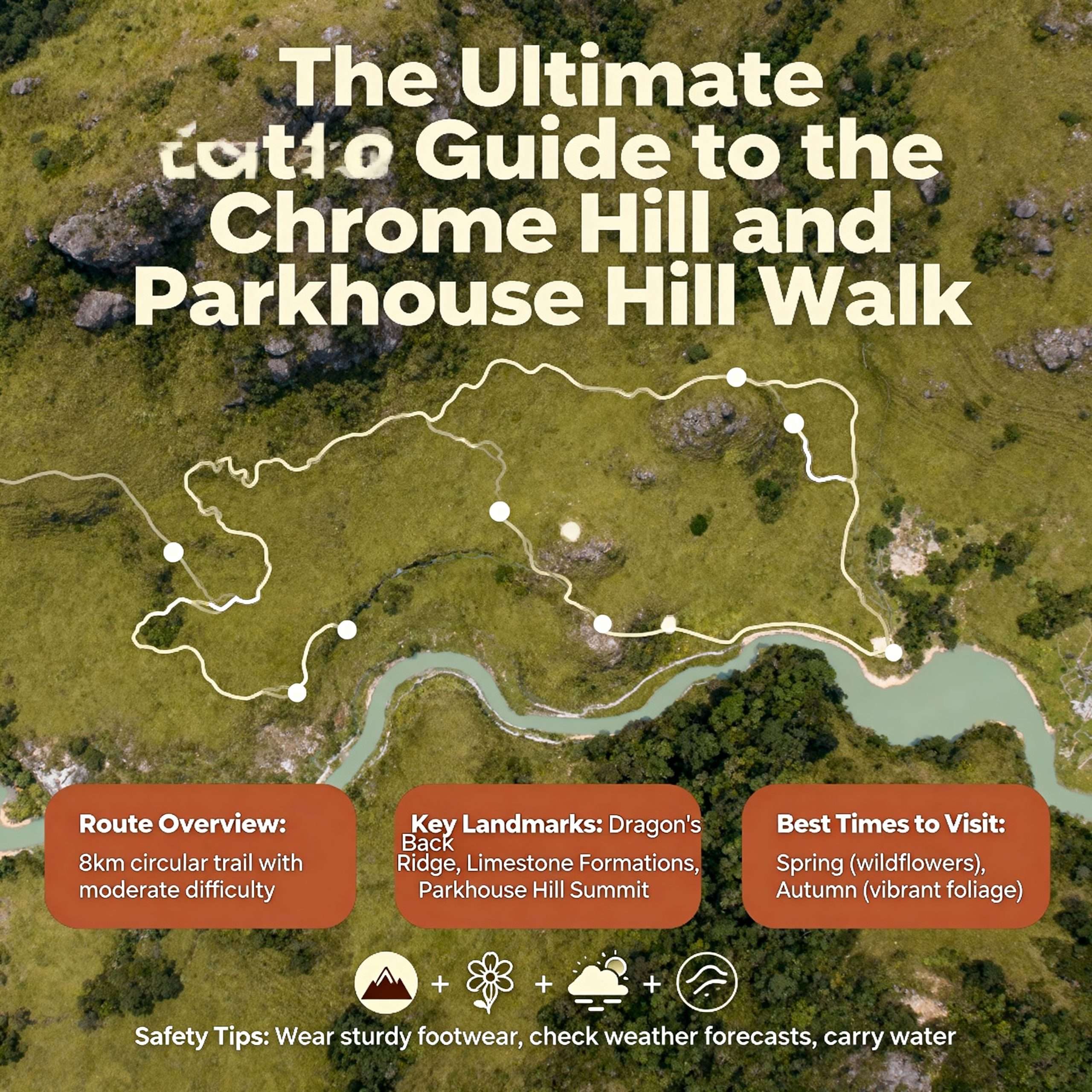
The Chrome Hill and Parkhouse Hill Walk is arguably the most visually striking journey in the White Peak, offering a landscape that feels more like the jagged Alps than the rolling hills of Derbyshire. Known affectionately as the “Dragon’s Back” due to the serrated silhouette the hills create against the skyline, this White Peak ridge walk is a rite of passage for any serious hiker. Unlike the vast gritstone plateaus found on the Stanage Edge Walk, these limestone “reef knolls” provide sharp, steep ascents and narrow ridges that demand respect and a steady foot. As one of the most unique Peak District Day Hikes, it offers a concentrated dose of drama, geology, and breathtaking views over the upper Dove Valley.
For those seeking a Chrome Hill walk, the experience is defined by the unique limestone geology of the region. These hills are the remains of a 340-million-year-old coral reef that sat at the edge of a tropical lagoon. Today, they stand as isolated peaks, rising abruptly from the surrounding farmland. A Parkhouse Hill walk is equally compelling, often considered the more challenging of the two due to its steeper gradients and the “hands-on” nature of its limestone spine. Together, they form a Peak District limestone hills walk that is short in distance but high in intensity, making it a favourite for photographers and hillwalkers alike.
While many visitors flock to the Mam Tor Great Ridge Walk for its accessibility, the Chrome Hill and Parkhouse Hill Walk offers a more rugged and technical experience. The terrain here is unforgiving in wet weather, and the exposure on the ridges can be exhilarating or intimidating depending on your experience level. This guide provides everything you need to navigate these iconic peaks safely, from parking logistics to step-by-step route descriptions, ensuring you can tackle the Dragon’s Back with confidence.

Chrome Hill and Parkhouse Hill Walk
The Chrome Hill and Parkhouse Hill Walk is a masterclass in limestone scenery. The hills are located near the village of Hollinsclough, tucked away in a quiet corner of the National Park that feels worlds away from the busier tourist hubs. The Peak District National Park Authority manages much of the surrounding infrastructure, but these hills themselves are situated on Open Access land, meaning hikers have the right to roam across the designated areas. However, because the hills are surrounded by working farmland, staying to the established paths is essential for conservation and local relations.
What makes a Chrome Hill walk so special is the sense of scale. Although Chrome Hill only reaches an elevation of 425 metres, its sharp profile makes it feel much higher. The ridge is narrow, and the views from the summit look directly down onto the smaller, but pointier, Parkhouse Hill. A Parkhouse Hill walk is often tackled in conjunction with its larger neighbour, creating a circular loop that tests your legs and your head for heights. This White Peak ridge walk is not just about the physical challenge; it is about immersing yourself in a landscape that Natural England identifies as one of the most significant geological sites in the country.
The Peak District limestone hills walk experience is also deeply tied to the seasons. In spring, the limestone grasslands are carpeted with wildflowers, including rare orchids and wild thyme. In winter, the hills take on a skeletal, prehistoric appearance, especially when dusted with snow. Regardless of when you visit, the Chrome Hill and Parkhouse Hill Walk remains one of the most rewarding short hikes in the UK, providing a sense of adventure that far outweighs its modest mileage.
Route Overview and Key Facts
Before you lace up your boots for the Chrome Hill and Parkhouse Hill Walk, it is vital to understand the technical nature of the route. This is not a flat stroll; it involves significant steepness and some light scrambling. If you have previously enjoyed the Stanage Edge Walk, you will find the terrain here much more vertical and the footings more polished.
- Distance: Approximately 6.5 kilometres (4 miles) for the standard circular loop from Hollinsclough.
- Time: 2.5 to 4 hours. The short distance is deceptive; the steep climbs and descents require a slow, deliberate pace.
- Total Ascent: Roughly 350 metres, much of which is concentrated in two very sharp bursts.
- Terrain: Steep limestone ridges, grassy slopes, and some rocky sections that can be extremely slippery when wet.
- Difficulty: Moderate to Hard. While no specialist climbing gear is needed, a Parkhouse Hill walk involves steep sections that some may find daunting.
- Navigation: Generally clear in good weather, but the paths on the hills themselves are narrow and can be obscured by low cloud.
The Chrome Hill walk section is generally considered the easier of the two, with a more defined path leading up the “tail” of the dragon. In contrast, the White Peak ridge walk over Parkhouse Hill is steeper and requires occasional use of hands for balance. This Peak District limestone hills walk is best suited for hikers with a reasonable level of fitness and good quality, high-grip footwear.
Starting Point and Parking Options
Accessing the Chrome Hill and Parkhouse Hill Walk can be a challenge, as the roads leading to the area are narrow, single-track lanes with few passing places. There is no large, dedicated car park for these hills, so sensible and respectful parking is mandatory to avoid blocking access for local farmers and emergency services.
1. Hollinsclough Village: This is the most common starting point. There is a small amount of on-street parking near the village hall and the church. However, spaces are very limited. If you park here, ensure you are not obstructing any gates or driveways. From the village, a quiet lane leads directly toward the base of Chrome Hill.
2. Earl Sterndale: Located to the south of Parkhouse Hill, this village offers an alternative starting point. There is some parking available around the village green, near the famous “Quiet Woman” pub. Starting here allows you to tackle the Parkhouse Hill walk first before moving on to Chrome Hill. It adds a little more distance to the walk but offers a different perspective on the ridges.
3. Lay-bys on the B5053: There are a few small gravel lay-bys on the main road between Glutton Bridge and Longnor. These are often used by hikers, but they fill up quickly on weekends. From here, you can walk across the fields to reach the foot of the Dragon’s Back.
Given the popularity of the Chrome Hill and Parkhouse Hill Walk, it is highly recommended to arrive early—ideally before 9:00 AM—especially during the summer months or on bank holidays. If the parking areas are full, please have a backup plan, such as the Mam Tor Great Ridge Walk, rather than parking dangerously on the narrow verges.
Step-by-Step Route Description
This Chrome Hill and Parkhouse Hill Walk description follows a clockwise loop starting from the village of Hollinsclough, which is the most intuitive way to experience the “Dragon’s Back” profile.
Phase 1: The Approach from Hollinsclough
From the centre of Hollinsclough, head south along the narrow lane toward the base of the hills. You will pass a few farm buildings before reaching a gate that leads onto the open hillside. The Chrome Hill walk begins here. The path climbs steadily at first, following the lower slopes of the hill. As you gain height, the views back toward the village and the surrounding moors begin to open up. The path eventually swings around to the northern end of the ridge, where the real climbing begins.
Phase 2: Ascending Chrome Hill
The ascent of Chrome Hill is steep but follows a relatively well-trodden grassy path. As you reach the ridge, the ground drops away sharply on both sides. This is the classic White Peak ridge walk experience. Continue along the spine of the hill, passing through a small gate. The summit is marked by a small rocky outcrop. From here, you can see the entire length of the Chrome Hill and Parkhouse Hill Walk laid out before you. The descent from Chrome Hill toward the road at Glutton Bridge is very steep and can be hard on the knees; take your time and use trekking poles if you have them.
Phase 3: The Crossing to Parkhouse Hill
After descending Chrome Hill, you will reach a small road. Cross this carefully to reach the base of Parkhouse Hill. This is the start of the Parkhouse Hill walk. Unlike Chrome Hill, there is no “easy” way up Parkhouse. The path goes straight up the nose of the hill. The limestone here is very polished from years of foot traffic, making it slippery even in dry conditions. You may need to use your hands in a few places to steady yourself as you scramble up the initial rocky steps.
Phase 4: The Parkhouse Ridge
Once you reach the top of the first steep pitch, you are on the narrowest part of the Peak District limestone hills walk. The ridge of Parkhouse Hill is incredibly sharp, with steep drops into the valley on either side. Follow the undulating spine toward the summit. The views from here, looking back at the massive bulk of Chrome Hill, are some of the best in the Peak District. The descent from the far end of Parkhouse Hill is equally steep and requires careful footwork to avoid a slip on the loose scree and grass.
Phase 5: The Return via the Valley
After safely descending Parkhouse Hill, the Chrome Hill and Parkhouse Hill Walk concludes with a gentle return to Hollinsclough. Follow the lower path that runs along the base of the hills. This section allows you to look up at the ridges you have just traversed, providing a great sense of achievement. The path leads through several fields and farm gates before reconnecting with the lane back into the village. This lower section can be quite boggy, so be prepared for some mud even if the ridges were dry.
Difficulty, Scrambling and Exposure
The Chrome Hill and Parkhouse Hill Walk is often underestimated because of its short distance. However, the technicality of the terrain puts it in a different category than most Peak District Day Hikes. The primary difficulty lies in the steepness of the gradients. Both hills require significant physical effort to ascend, and the descents are steep enough to be challenging for those with joint issues.
Scrambling is a key feature of a Parkhouse Hill walk. While it is only “Grade 1” (the easiest level of scrambling), it still involves moving over rock where you will likely need to use your hands for balance. The limestone is notoriously slick. Over decades, thousands of boots have polished the rock surfaces, making them feel almost like glass in certain sections. This is particularly true on the “nose” of Parkhouse Hill. If you are not comfortable with basic scrambling, you may find this section of the White Peak ridge walk stressful.
Exposure is the other major factor. The ridges are narrow, and while there is usually enough room to walk comfortably, the proximity of steep drops can be intimidating. On a Chrome Hill walk, the ridge is slightly wider, but on Parkhouse, it feels much more acute. If you are prone to vertigo, the Chrome Hill and Parkhouse Hill Walk will certainly test your limits. However, for most hikers, this exposure is exactly what makes the route so exhilarating and memorable.
Safety, Weather and Limestone Terrain Advice
Safety is paramount on the Chrome Hill and Parkhouse Hill Walk, primarily due to the nature of limestone. Unlike the gritstone found on the Stanage Edge Walk, which remains grippy even when damp, limestone becomes treacherous when wet. A light drizzle can turn the Peak District limestone hills walk into a skating rink. If rain is forecast, or if it has rained recently, extreme caution is advised, particularly on the descents.
Weather conditions can change rapidly in the Dove Valley. The hills are exposed to the wind, and because they stand in isolation, gusts can be much stronger on the ridges than in the sheltered valleys below. High winds can make the narrow ridge of a Parkhouse Hill walk dangerous, as a sudden gust could easily knock a hiker off balance. Always check the local forecast and be prepared to turn back if conditions deteriorate. If you do encounter trouble, Mountain Rescue England & Wales can be reached by calling 999 and asking for the Police, then Mountain Rescue.
Finally, navigation on the Chrome Hill and Parkhouse Hill Walk is generally simple, but in thick mist, the ridges can become disorienting. Always carry a physical map (OS Explorer OL24) and a compass. While digital tools are useful, battery life can fail in the cold, and the steep hills can sometimes interfere with GPS signals. By being prepared and respecting the unique challenges of the limestone terrain, you can ensure that your White Peak ridge walk is a safe and spectacular experience.
The Chrome Hill and Parkhouse Hill Walk is a true gem of the British countryside. It offers a level of drama and geological interest that is rare for such a short route. Whether you are tackling the Chrome Hill walk for the views or the Parkhouse Hill walk for the physical challenge, the Dragon’s Back will leave a lasting impression. It is a place where the ancient history of the earth is written in the rocks, and where every step offers a new and breathtaking perspective on the White Peak. Once you have completed this Peak District limestone hills walk, you will understand why it remains one of the most beloved routes in the entire National Park.
