A good sleeping pad is the foundation of wilderness comfort—literally. While tents and sleeping bags get most of the attention, your sleeping pad determines whether you wake up refreshed or stiff from sleeping on cold, uneven ground.
But how do you choose a sleeping pad that actually works for British conditions? With our unpredictable weather—frosty Highland nights in June, soggy Lake District camps, and wild coastal bivvies—UK hikers face unique challenges that demand careful pad selection. Look for sleeping pads that offer a good balance between insulation and weight, ensuring they can handle the temperature fluctuations typical of UK climates. Additionally, consider materials that provide durability and waterproofing, which are essential for the damp conditions often encountered. For those venturing into the great outdoors, check out our Best Sleeping Bags UK 2025 to make the most of your experience. Additionally, it’s wise to read reviews and compare options to identify the best sleeping pads in the UK, as personal comfort and preferences can vary significantly among hikers. Features like packability and ease of inflation can also enhance your camping experience, ensuring you can quickly set up after a long day on the trail. Ultimately, investing in the right sleeping pad can make all the difference in enjoying restful nights, regardless of what the British weather throws your way.
This complete guide breaks down everything you need to know: R-values explained simply, how different pad types perform in UK conditions, matching your pad to your sleeping bag, and the critical mistakes that leave hikers cold and uncomfortable.
Whether you’re planning a summer wild camp in Snowdonia or a winter bothy trip in the Cairngorms, you’ll learn exactly how to choose a sleeping pad that keeps you warm, comfortable, and sleeping soundly on British trails. In addition to selecting the right sleeping pad, it’s essential to consider your gear’s overall weight and packability for those long treks. To further enhance your outdoor experience, don’t overlook hiking boot selection tips to ensure your feet remain blister-free and well-supported on unpredictable terrains. Ultimately, being well-prepared will turn your adventure into a memorable journey through the breathtaking landscapes of the British countryside.
Understanding R-Value: The Only Number That Actually Matters
R-value measures thermal resistance—how well a sleeping pad insulates you from cold ground. It’s the single most important specification to understand, because ground cold steals body heat 25x faster than air.
The higher the R-value, the better the insulation:
- R-Value 1-2: Summer only (above 10°C/50°F)
- R-Value 2-4: 3-season UK hiking (5-10°C/40-50°F)
- R-Value 4-6: Cold weather & shoulder seasons (-5 to 5°C/20-40°F)
- R-Value 6+: Winter & mountain expeditions (below -5°C/20°F)
For example, the Therm-a-Rest NeoAir XLite (R-4.5) works brilliantly for most UK 3-season hiking—spring through autumn at lower elevations. Its compact size and lightweight design make it a favorite among hikers looking to optimize their ultralight backpacking gear in UK conditions. Additionally, the NeoAir XLite provides excellent insulation and a comfortable sleeping experience, ensuring a restful night’s sleep after a long day on the trails. With its durability and ease of use, it stands out as an essential item for any outdoor enthusiast. Pairing the NeoAir XLite with one of the best ultralight backpacks for hiking maximizes efficiency and comfort on your outdoor adventures. When you choose a backpack designed for lightweight travel, you’ll find it easier to navigate varied terrain while carrying your essential gear. Together, they create a streamlined setup that enhances your overall hiking experience, allowing you to focus on the beauty of nature around you.
The Therm-a-Rest NeoAir XLite is an excellent example of balancing warmth, weight, and packability.
Why UK Hikers Need Higher R-Values Than Expected
Many hikers underestimate what R-value they need in the UK. Our maritime climate creates surprisingly cold ground conditions even in summer:
- Highland camps above 600m: Can drop to 5°C even in July
- Coastal wild camping: Constant wind chill and damp ground
- Lake District valleys: Notorious cold spots due to katabatic winds
- Pennine Way moorland: Boggy ground that saps heat aggressively
The UK Rule of Thumb: Add 1 R-value point above what you think you need. If a pad is rated for “3-season,” assume that’s California 3-season, not Scottish 3-season.
Can You Stack R-Values?
Yes! R-values are additive when you stack pads. This creates versatile sleep systems:
- Summer Setup: Single R-4 inflatable = lightweight
- Autumn Setup: R-4 inflatable + R-1.5 foam pad = R-5.5 (warmer)
- Winter Setup: R-5 insulated pad + R-2 foam = R-7 (very warm)
Many UK thru-hikers carry a thin foam pad (like Therm-a-Rest Z-Lite) as backup and stack it with their inflatable in cold conditions. Smart system design.
Types of Sleeping Pads: Pros & Cons for UK Conditions
There are three main types, each with distinct advantages for British hiking:
1. Air Pads (Inflatable)
Best for: Lightweight backpacking, comfort seekers, side sleepers
UK Performance: Excellent for 3-season hiking; requires careful handling
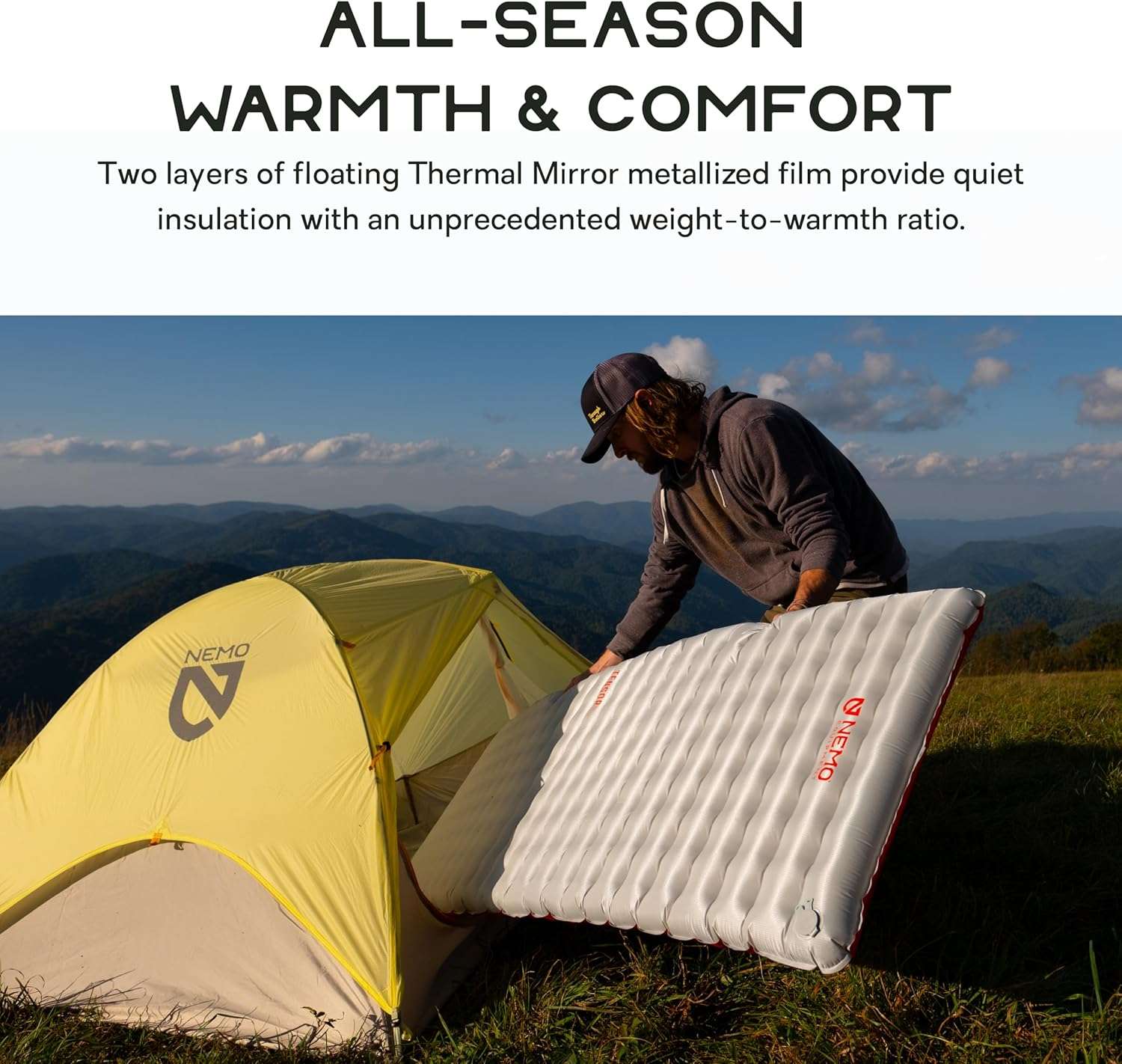
Modern air pads like the Nemo Tensor Insulated deliver incredible comfort-to-weight ratios—often 8cm thick but weighing under 500g.
✅ Pros:
- Extremely lightweight (300-500g)
- Pack incredibly small (water bottle size)
- Very comfortable (3-4″ thick)
- Best warmth-to-weight ratio
❌ Cons:
- Vulnerable to punctures (thorns, sharp rocks)
- Noisy when you shift position
- Requires inflation (pump or lungs)
- Can fail catastrophically
UK-Specific Considerations:
- Bring a repair kit (essential on multi-day trips)
- Avoid rocky Highland pitches with minimal soil
- Store inflated inside tent overnight (protects from thorns, rocks)
- Test inflation valve in cold conditions before trips
2. Self-Inflating Pads (Foam Core)
Best for: Reliability, beginners, variable terrain, car camping
UK Performance: Bulletproof in rugged conditions; heavier but dependable
These hybrid pads combine open-cell foam with air chambers. Open the valve and they partially self-inflate, then you top them off with a few breaths.
✅ Pros:
- Extremely durable (almost puncture-proof)
- Self-inflating = easy setup
- Comfortable (2-3″ thick)
- Forgiving on rocky ground
❌ Cons:
- Heavier (800-1200g)
- Bulkier packed size
- Foam absorbs moisture over time
- Not as warm per weight as air pads
UK-Specific Considerations:
- Excellent for Scottish Highlands (rocky terrain)
- Ideal for beginners learning wild camping
- Store loosely rolled at home (maintains foam loft)
- Slower to inflate in very cold conditions
3. Closed-Cell Foam Pads
Best for: Ultralight hiking, bivy camping, bombproof reliability, budget
UK Performance: Unbeatable durability; trade comfort for reliability
Simple foam pads that never fail. The classic Therm-a-Rest Z-Lite Sol is the UK thru-hiker’s favorite backup pad.
✅ Pros:
- Indestructible (no punctures, no failures)
- Instant setup (unroll and done)
- Doubles as frame for frameless packs
- Very affordable (£30-60)
- Multi-use (sit pad, pack frame, emergency splint)
❌ Cons:
- Least comfortable (thin, firm)
- Bulky (strapped to outside of pack)
- Lower R-values (R-2 to R-3)
- Not great for side sleepers
UK-Specific Considerations:
- Perfect for bothy trips (no puncture risk)
- Excellent for coastal camps with minimal vegetation
- Strap outside pack for “instant sit pad” access
- Popular for minimalist bikepacking
Matching Your Sleeping Pad to Your Sleeping Bag
Your pad and bag work as a system—one can’t compensate for the other’s weaknesses.
Temperature Rating Math
Bag + Pad = System Rating
A “0°C sleeping bag” only works to 0°C if your sleeping pad provides adequate insulation. Otherwise, ground cold will defeat even the warmest bag.
Example:
- Sleeping Bag: Rated 0°C comfort (assumes R-4 pad)
- Sleeping Pad: R-2 (summer pad)
- Actual System Rating: ~10°C (not 0°C!)
The fix: Pair that 0°C bag with an R-4+ pad to achieve the advertised rating.
Why Sleeping Bag Insulation Gets Compressed
The insulation beneath you in a sleeping bag gets compressed by your body weight, reducing its loft to near-zero. This is why even the warmest down bag won’t keep you warm without a proper sleeping pad—there’s no insulation between you and the ground.
Bottom Line: Your sleeping pad IS your insulation for your back, hips, and shoulders. Choose its R-value accordingly.
UK Wild Camping System Recommendations
Spring/Summer (May-September):
- Sleeping Bag: 5°C to 0°C comfort
- Sleeping Pad: R-3.5 to R-4.5 (insulated air pad)
- Example: Nemo Tensor Insulated R-4.4 + 5°C quilt
Autumn/Spring Shoulder Season (March-April, October-November):
- Sleeping Bag: -5°C to 0°C comfort
- Sleeping Pad: R-4.5 to R-5.5 (insulated air or stacked pads)
- Example: R-4 air pad + R-1.5 foam = R-5.5 system
Winter & High Mountains (December-February, or year-round above 900m):
- Sleeping Bag: -10°C to -15°C comfort
- Sleeping Pad: R-6+ (winter-rated insulated pad or stacked system)
- Example: Sea to Summit Ether Light XT (R-6.2) for serious winter insulation
UK-Specific Sleeping Pad Considerations
British hiking conditions demand specific pad features:
1. Damp Ground Performance
UK camps are often wet. Consider:
- Top fabric: Grippy, non-slip textures (you don’t slide off wet pads)
- Bottom fabric: Waterproof coating (protects from ground moisture)
- Foam pads: Closed-cell foam resists water absorption
Pro Tip: Always use a groundsheet or footprint beneath your sleeping pad. Even waterproof pads last longer when protected from abrasion and ground moisture.
2. Wind Chill Resistance
Exposed Highland and coastal camps experience relentless wind. Look for:
- Reflective layers: Silver/gold films (Therm-a-Rest ThermaCapture)
- Multiple air chambers: Reduce convective heat loss
- Insulation baffles: Vertical baffles outperform horizontal in wind
The Science: Wind accelerates convective heat loss through air pads. Insulated pads with reflective layers combat this effectively.
3. Puncture Risk Management
UK terrain varies from soft peat to sharp Highland schist. Strategies:
- For Rocky Terrain: Self-inflating or closed-cell foam
- For Moorland/Grass: Insulated air pads work great
- For Mixed Terrain: Air pad + thin foam as groundsheet
Repair Kits: Always carry on multi-day trips. A small puncture shouldn’t end your hike.
Common Mistakes When Choosing Sleeping Pads
1. Prioritizing Comfort Over Warmth
Cold pads ruin sleep. Get the R-value right first, then optimize for comfort.
2. Buying Summer Pads for “3-Season” UK Use
“3-season” means different things in different climates. For UK hiking, assume you need an extra R-value point.
3. Ignoring Packed Size
Inside vs. outside pack storage matters. Bulky pads strapped externally get snagged on Highland boulder fields and scraped by rock faces.
4. Skipping the Pump Sack
Inflating with your breath introduces moisture, which freezes in cold conditions and reduces insulation. Use a pump sack.
5. Not Testing Before Trips
Valves can malfunction, seams can fail. Inflate your pad at home before heading into the wilderness.
Where to Buy Sleeping Pads in the UK
Specialist Retailers (Expert Advice):
- Cotswold Outdoor: Wide selection, knowledgeable staff, good returns policy
- Tiso: Scottish specialist, excellent for Highland hiking advice
- Alpkit: Budget-friendly UK brand with solid mid-range options
- Ultralightoutdoorgear.co.uk: Curated selection for lightweight backpackers
Online Retailers (Best Prices):
- Amazon UK: Convenient, fast delivery, good return policy (check for authentic products)
- Wiggle/Chain Reaction Cycles: Occasional steep discounts
- eBay UK: Second-hand gear from thru-hikers (inspect carefully)
Pro Tip: Buy from retailers with generous return policies. Sleeping pads are personal—what works for one person may not suit another. Test at home and return if needed.
Final Thoughts: How to Choose a Sleeping Pad That Actually Works
The best sleeping pad for UK hiking is the one that:
- Keeps you warm (appropriate R-value for your coldest expected night)
- Survives UK terrain (durable enough for your typical camping spots)
- Fits your pack (packed size that works with your backpack style)
- Matches your budget (£80-200 range covers most quality pads)
For most UK hikers, a 3-season insulated air pad with R-4 to R-5 is the sweet spot—light enough for long trails, warm enough for unpredictable British weather, and comfortable enough for restorative sleep.
Remember: your sleeping system is a chain—tent, pad, bag, clothing—and the weakest link determines your comfort. Get the R-value right, test before you trek, and you’ll sleep soundly on every British trail. As you prepare for your journey, consider the seasonal variations and your personal preferences for temperatures on the trail. The West Highland Way overview 2025 highlights essential tips for optimal gear choices, ensuring you can tackle the varying Scottish weather with ease. Prioritize testing your gear in similar conditions to those you’ll face, allowing for any necessary adjustments before hitting the trail. Additionally, familiarizing yourself with the pennine way trail overview can provide valuable insights into the terrain and climate you’ll encounter. Consider consulting local guides and resources to enhance your understanding of the path, including tips on hydration and food planning for long stretches. The more informed you are, the better your chances of having a rewarding and comfortable journey.
